
You know they block wind. You know they keep rain out. But what’s it actually like to live with zip track blinds by the ocean?
After talking to homeowners and property managers in Florida, Australia, and Southeast Asia, here’s what we’ve learned about the real-world experience—the good and the things you should plan for.
The First Thing You'll Notice: The Quiet
People expect wind protection. They don’t expect the silence.
One homeowner in Queensland told us: “I didn’t realize how much noise my old blinds made until I replaced them. The flapping, the rattling—I’d just gotten used to it.”
With zip track blinds locked into side channels, there’s nothing to flap. No banging against the frame when a gust hits. Just… quiet.
That matters more than you think when you’re trying to read, work from home, or have a conversation outside.
What Salt Air Actually Does (And What It Doesn't)
Here’s the honest answer about salt corrosion.
The parts that hold up: Our powder-coated aluminum frames and tracks. The coating is baked on, not just sprayed. Salt doesn’t penetrate it.
The parts that need attention: Stainless steel is corrosion-resistant, not corrosion-proof. In extreme coastal conditions (think waves breaking at your property line), even good hardware can show surface rust after 5-7 years.
What we’ve learned: Rinse the tracks with fresh water every few months. Takes five minutes. Adds years to the hardware life.
A property manager in the Maldives said: “We hose down all our outdoor blinds once a month. The ones we skip? Those show wear. The ones we maintain? Still look new after four years.”
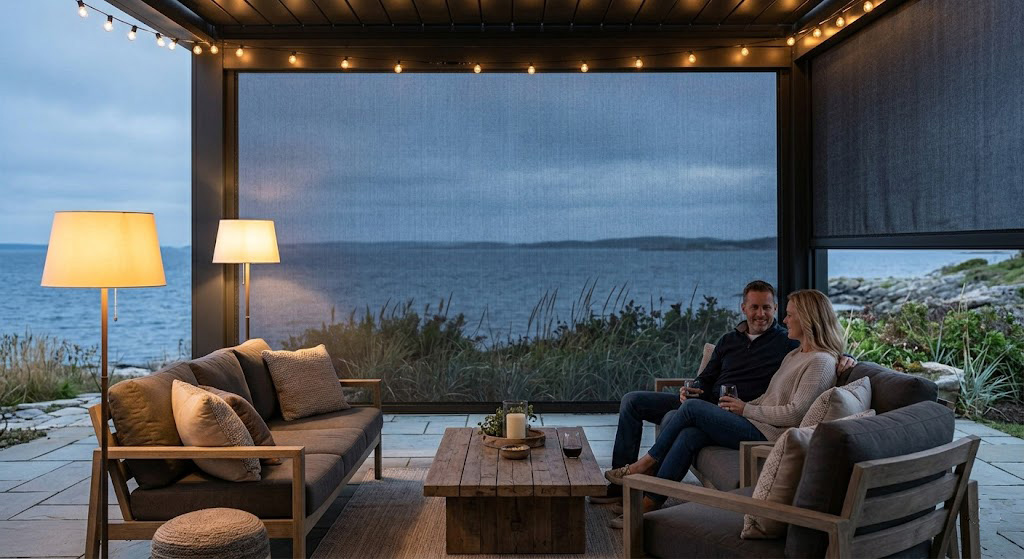
The Fabric Choice That Actually Works for Coast
Not all outdoor fabrics are the same near the ocean.
What fails fast: Cheap PVC. It gets stiff, cracks, and looks chalky within two years in high-UV coastal areas.
What lasts: High-density polyester with UV stabilizers. It breathes better (less heat trapped underneath) and stays flexible.
A specific recommendation: If you’re within 500 meters of the ocean, avoid light-colored mesh fabrics. They look clean at first, but salt residue shows up as white streaks that are surprisingly hard to wash off. Go with darker tones or speckled patterns that hide the salt marks between cleanings.
One Thing Nobody Mentions: Sand
Windproof blinds are great at blocking wind. That same wind carries sand.
Here’s what happens: Sand gets into the bottom track. Not a lot. But over months, it builds up.
The fix: Vacuum the bottom track twice a year. That’s it. Takes ten minutes.
A villa owner in Dubai learned this the hard way. “I didn’t clean the tracks for two years. The blind stopped going down smoothly. I thought the motor was broken. Nope—just compacted sand.”
When to Leave Them Down vs. Roll Them Up
Common question: “Should I leave my zip track blinds down all the time?”
Our answer: Depends on your exposure.
| Situation | Recommendation |
|---|---|
| Protected balcony, mild winds | Leave them down. Fabric is fine. |
| Full ocean exposure, constant wind | Roll them up when not in use. Constant wind vibration wears fabric faster. |
| Storm forecast | Roll them up. No fabric is designed for hurricane-force sustained wind. |
| Away for months (vacation home) | Roll them up. Less UV exposure, less salt buildup. |
A homeowner in Cape Town said: “I used to leave mine down year-round. After three years, the fabric showed more wear than my neighbor’s who rolls hers up in winter. Now I roll them up. Problem solved.”
The Real ROI: Usable Days Per Year
Here’s the number that actually matters.
Before zip track blinds: Maybe 150 usable days per year. Windy days = inside days.
After zip track blinds: 280-300 usable days. Windy days become comfortable outdoor days.
A restaurant owner in Greece put it simply: “I added three months to my outdoor dining season. That paid for the blinds in the first year.”
Bottom Line
Zip track blinds work in coastal areas. They block wind, reduce noise, and extend your outdoor season.
But they’re not magic. They need basic maintenance. Fabric choice matters. And you should roll them up when big storms come.
Do those three things, and they’ll last 10-15 years even with salt air.
Skip them, and you’ll be replacing fabric or motors sooner than you’d like.
ANYHOO — 18 years of making outdoor blinds for people who actually use them.