
For commercial architects, developers, and hoteliers, outdoor space is revenue space. And wind is the silent profit killer.
You’ve seen it before. A beautifully designed patio with premium furniture, string lights, and custom planting—rendered completely unusable whenever the breeze picks up. Tablecloths flying. Glasses tipping. Customers moving inside, taking their spending with them.
Wind isn’t just an inconvenience. In commercial settings, it’s a direct hit to your bottom line.
The Engineering Reality Behind "Windproof"
Most outdoor blind suppliers claim wind resistance. Few can prove it.
In Europe, the standard EN 1932 defines clear performance classes for external blinds, with Class 5 representing 270 N/m² (approx. 76 km/h) and Class 6 reaching 400 N/m² (approx. 92 km/h). These aren’t marketing claims—they’re engineering specifications that determine whether a shading system survives or fails.
For zip track blinds, the physics works differently than standard roller blinds. In a conventional system, wind catches the fabric edges and creates flutter—small movements that stress the material, fatigue the hardware, and eventually cause failure.
Zip track systems lock the fabric into side channels using a spline or zipper mechanism. Wind load transfers from the fabric to the tracks, distributing pressure evenly across the entire structure rather than concentrating it at a few mounting points.
What the Testing Actually Shows
Independent testing on track-guided blind systems reveals what “windproof” really means in measurable terms:
A standard 2.5m x 2.5m zip track blind, installed with recommended fixings for windy areas, withstood a static load equivalent to 172 km/h wind speed—roughly 876 kg of force before failure.
The spline system alone, which holds the fabric in the side tracks, required more than 480 kg per metre of horizontal force to pull out.
For comparison, the same testing found that a similar blind installed with standard (non-windy-area) fixings achieved significantly lower wind performance. The difference? Approximately 30% improvement simply from using the correct mounting hardware and spacing.
Why This Matters for Commercial Projects
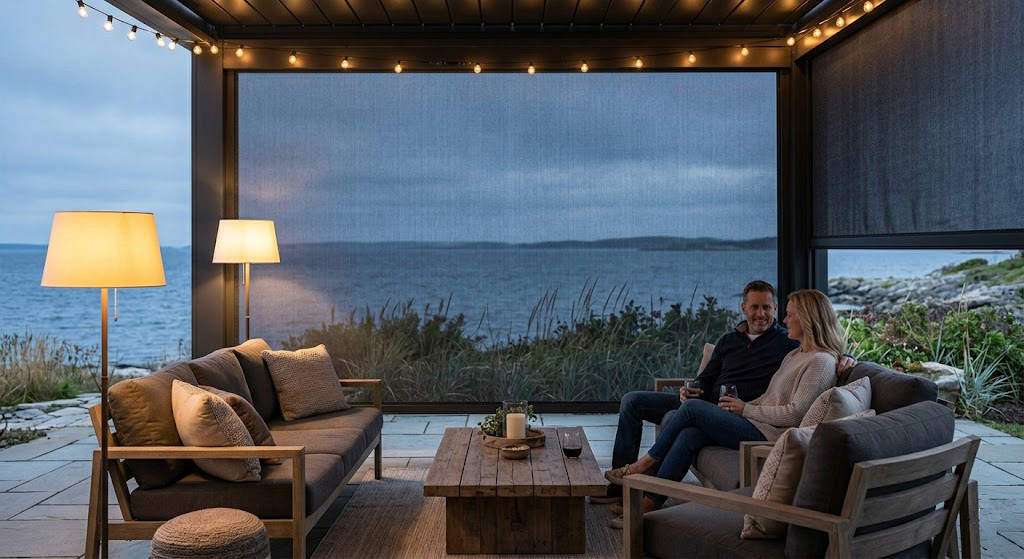
For a hotel patio, restaurant terrace, or residential development balcony, wind resistance translates directly to usable days per year.
Track-guided systems offer three distinct advantages over standard outdoor blinds:
1. No fabric flutter. The captured edges prevent the material from lifting and flapping, which means no noise, no wear, and no visual distraction.
2. Better rain deflection. When wind drives rain horizontally, side gaps in standard blinds become entry points. Zip track systems seal those gaps, significantly reducing water ingress.
3. Lower maintenance costs. The reduced fabric movement means less stress on seams, less hardware fatigue, and fewer repair calls.
The Engineering Reality Behind "Windproof"
The best engineering fails without proper installation.
Manufacturers like Ziptrak publish specific fixing recommendations based on blind size and location. For example, blinds over 4 metres wide require stainless steel rivets instead of aluminium, and closer fixing intervals to handle increased wind load.
What this means for specifiers: Always ask for the manufacturer’s wind rating data, not just “windproof” in the brochure. Demand the test conditions, the blind dimensions, and the fixing specifications used.
A Note on "Ziptrak" vs Generic Systems
“Ziptrak” is a specific Australian brand, but the technology is now available from multiple manufacturers. The key differentiator for commercial projects isn’t the brand name—it’s the engineering documentation.
At ANYHOO, our zip track blinds are designed around the same engineering principles: spline-guided fabric, corrosion-resistant aluminum tracks, and tested mounting systems. We provide wind load data specific to each blind configuration, because commercial specifiers need real numbers, not marketing language.
Making the Right Choice for Your Project
When specifying outdoor blinds for wind-exposed commercial spaces:
Ask for the classification. EN 1932 Class 5 or 6 indicates genuine engineering, not marketing talk.
Check the fixing specifications. The same blind installed with standard fixings can fail where a properly anchored version survives.
Consider the fabric. Lower openness fabrics (0-1%) offer significantly better wind and rain resistance than 5%+ mesh.
Plan for maintenance. Track systems need periodic cleaning to prevent debris buildup that impedes operation.
For spec sheets, wind load data, and engineering drawings of our commercial zip track systems, contact our technical team.
ANYHOO — 18 years of commercial outdoor shading with documented performance.